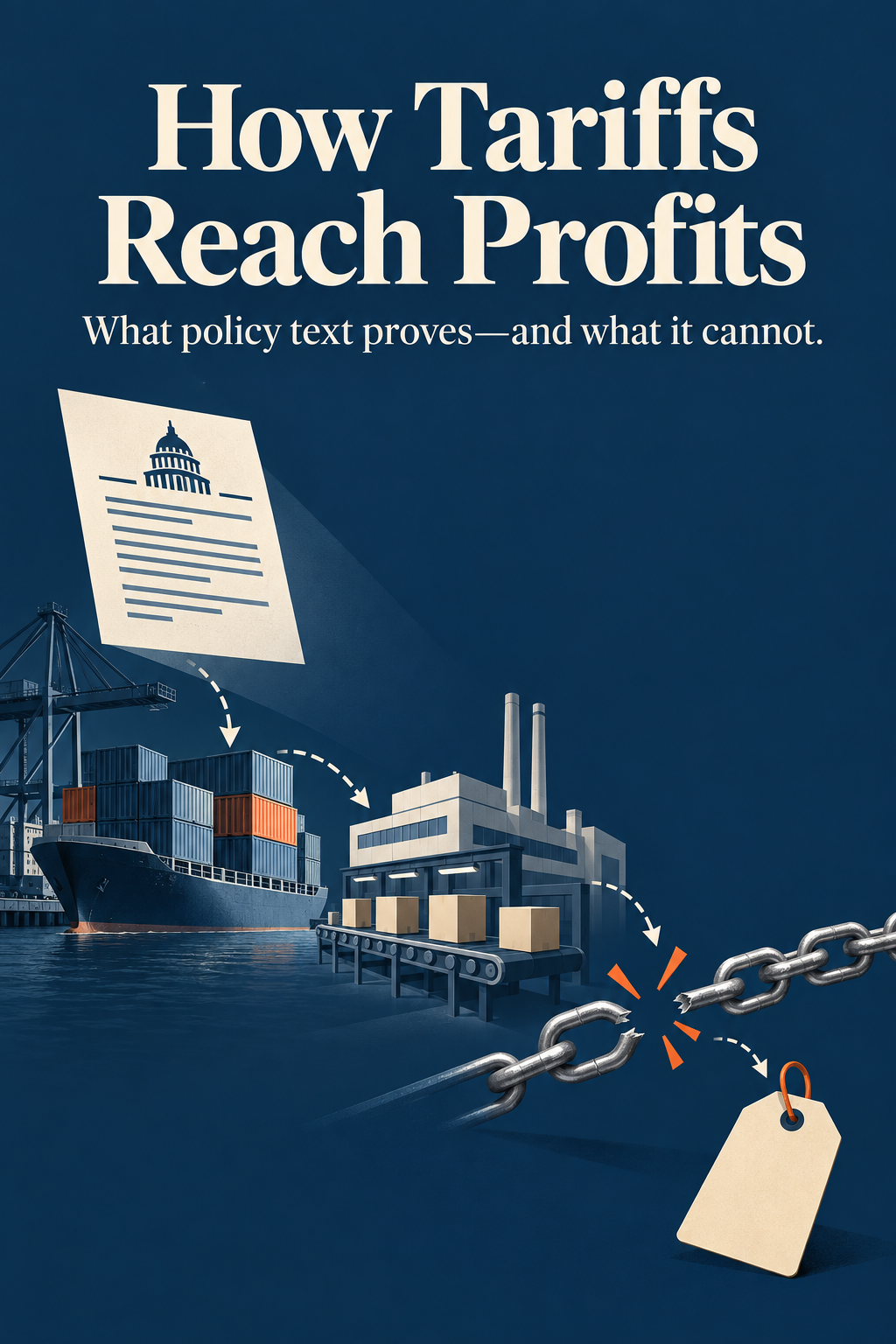
What judgment does this research establish, and what evidence would invalidate it?
1. Start with the evidence layers
The most common analytical error in trade-policy research is to translate a policy headline directly into a company earnings conclusion. A formal policy document can establish that a government took a particular legal action, subject to the scope and language actually documented. It does not, by itself, establish that a sector will benefit, that a company will win orders, or that the economy as a whole will improve.
This article uses the verified summaries of three public institutional sources: material from the Office of the United States Trade Representative concerning a July 23, 2026 final Section 301 action related to forced labor; a 2023 retrospective study summarized by the United States International Trade Commission; and a March 2026 World Trade Organization outlook. They serve different analytical purposes: a policy action, historical transmission evidence, and global trade context.
The USITC summary supports a limited historical conclusion. The relevant tariffs reduced affected imports and increased some US prices and output. It also explicitly limits the broader interpretation: those results do not establish a net gain for the whole economy. The USTR summary confirms a final action but does not, within the available evidence, provide the specific instrument, product coverage, tariff rate, or implementation schedule. The WTO summary discusses trade diversion and AI-related goods, but it cannot independently establish that any particular company received incremental orders.
2. Legal coverage comes before operating impact
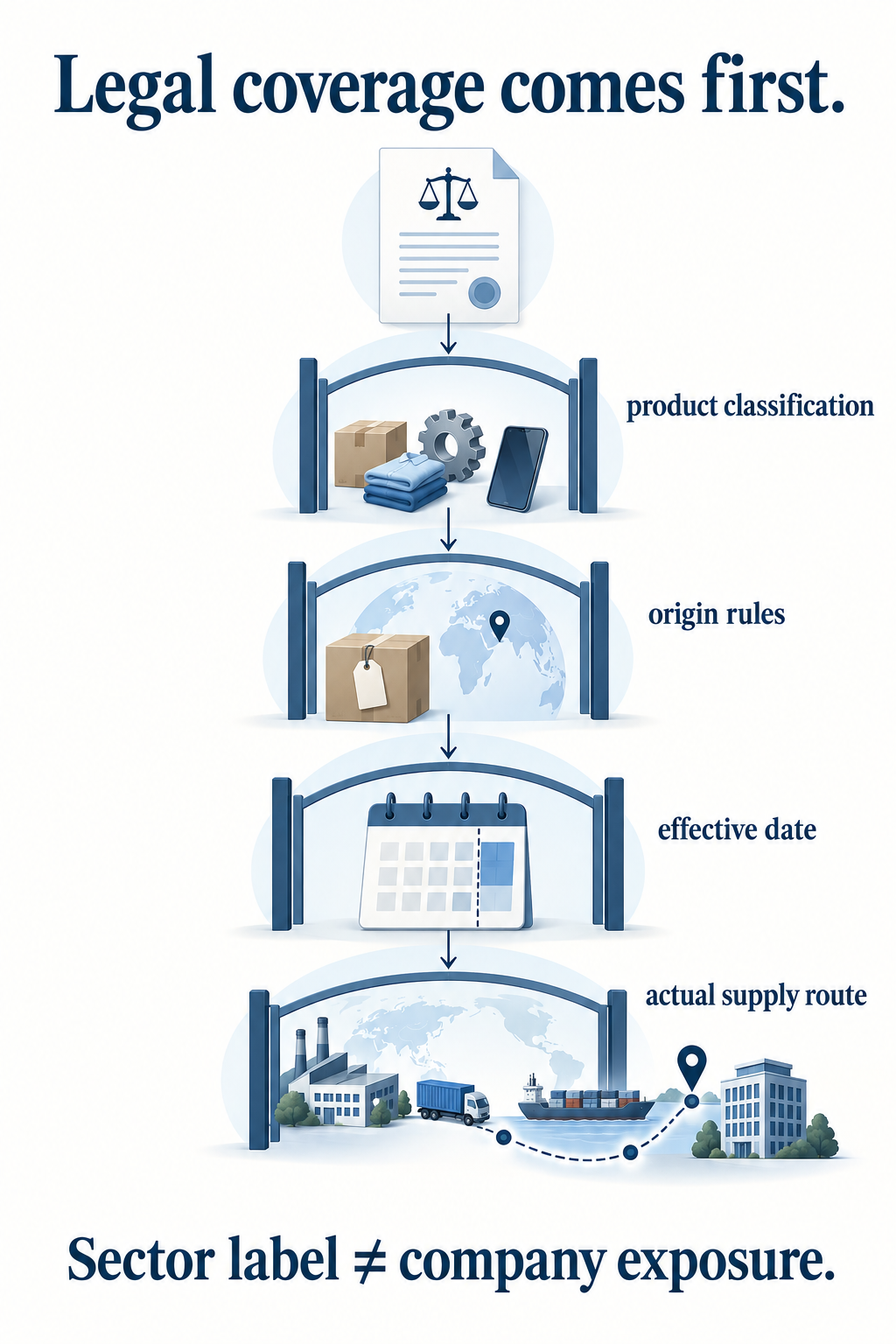
The first gate in company analysis is legal coverage. An analyst must identify the covered products, classification rules, origin requirements, effective dates, exclusions, amendments, and implementation guidance. Those conditions then need to be matched to the company’s actual products, supply routes, customers, and delivery obligations.
The available USTR summary confirms a final Section 301 action related to forced labor. It does not provide a text, annex, product list, or implementation guidance that can be used here to identify affected companies. We therefore cannot infer that a specific product carries a new duty, construct a company list, or treat a press-release headline as the complete execution rule.
This distinction matters because sector-level exposure is not company-level exposure. Products within the same industry may have different classifications, origins, exclusions, or effective dates. Even when a product is legally covered, the analyst still has to establish whether the company imports through the relevant route and which party bears the contractual obligation.
3. How a tariff enters costs and prices
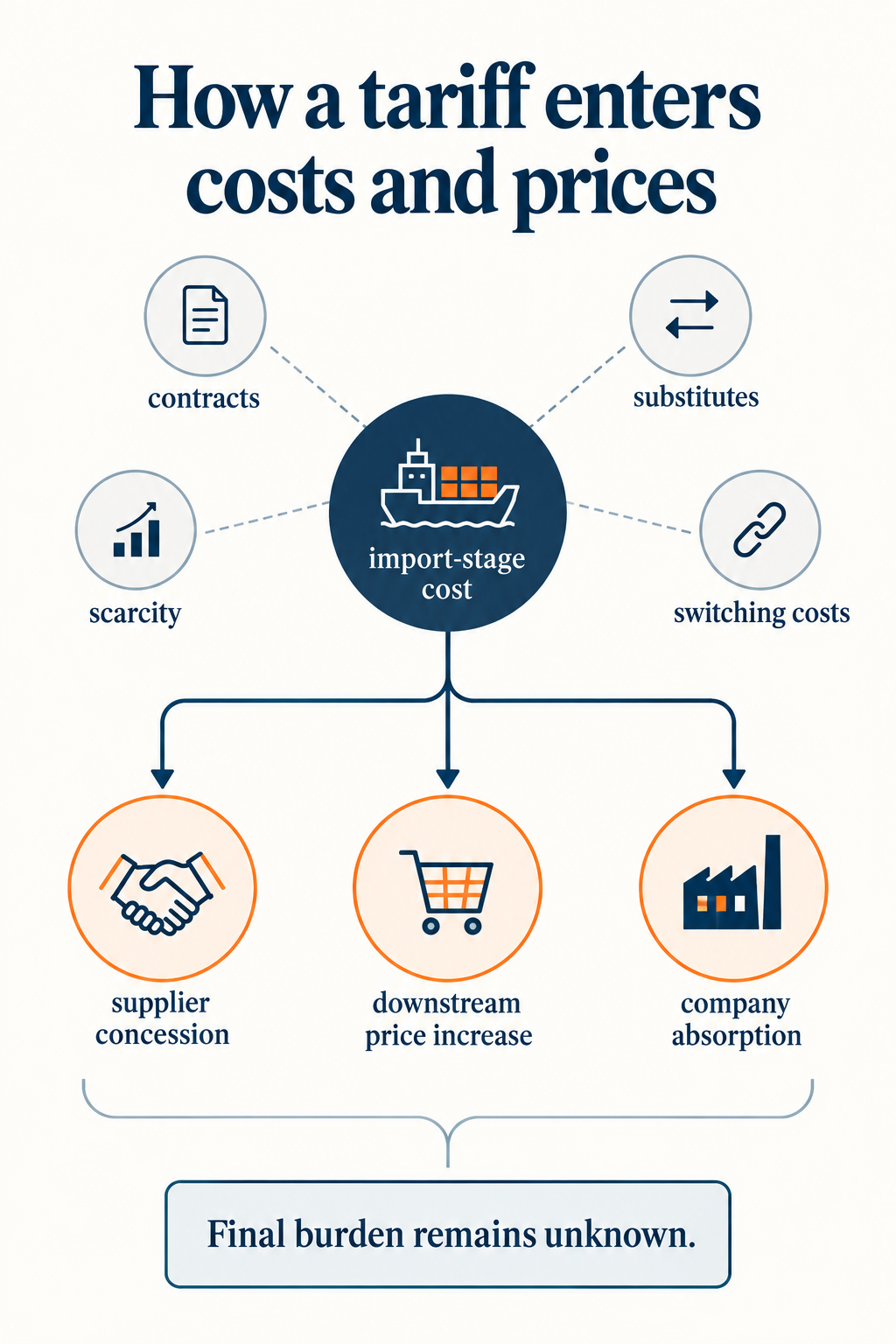
A tariff creates a payment obligation at the import stage, but the economic burden does not necessarily remain with the importer. An importer may pressure an overseas supplier to reduce its price, raise the price charged to downstream customers, absorb the cost temporarily, or use a combination of these responses across products and contracts.
The distribution of the burden depends on the availability of substitutes, product scarcity, contractual repricing rights, switching costs, customer concentration, and price sensitivity. Highly standardized products may create stronger pressure on suppliers to concede price. Products that require long certification cycles, dedicated tooling, or proven yields may give buyers less short-term flexibility.
As a result, the same policy can affect two companies very differently. A price increase observed near a policy announcement is not sufficient attribution. Raw-material costs, exchange rates, freight, demand, and product mix can all provide competing explanations. Without contracts, actual quotations, and import records, the final incidence of the cost remains unknown.
4. What historical research can and cannot tell us
The summarized 2023 USITC retrospective study provides the clearest directional evidence in this source set about actual economic transmission. According to the verified summary, the relevant tariffs reduced affected imports and increased some US prices and output. This supports a useful but limited proposition: trade restrictions can change relative prices and the allocation of production, and import contraction can coexist with increased domestic output in some areas.
The study’s analytical value is not a ready-made forecast. It reminds researchers to examine domestic prices, output, downstream input costs, and resource reallocation rather than watching import volumes alone. But the policies studied, time period, supply conditions, demand environment, and methods of a historical study may differ materially from a 2026 action.
The available summary does not provide verifiable sector estimates, product groupings, observation windows, methods, or uncertainty ranges. This article therefore does not cite elasticities, percentages, or projected gains. Using historical direction to formulate a testable hypothesis is appropriate. Applying historical magnitudes directly to another product group or company is not supported by the evidence.
5. Substitution operates on multiple clocks
When the landed cost of one supply route rises, a firm may switch suppliers, redesign a product, increase domestic sourcing, or delay procurement. But technical substitutability is not the same as commercial substitutability.
In the short term, existing certifications, tooling, yield stability, and delivery records may matter more than the quoted price. In the medium term, a buyer may complete supplier qualification, testing, and production adjustments. A longer-term relocation decision depends on policy durability, market scale, capital investment, and local ecosystem capacity.
These different clocks produce different operating signals. Short-term margin pressure does not rule out later substitution. A short-term order increase does not prove a durable competitive position. There is also a hidden-exposure problem: a nominal change in purchasing origin may not remove dependence if the new supplier still relies on critical inputs from the original source or does not change the applicable origin determination.
The available evidence contains no industry-specific certification timelines, available capacity, or completed-substitution data. Substitution must therefore remain a conditional mechanism, not an observed company outcome.
6. Trade diversion is not production migration
The summarized March 2026 WTO outlook provides context for examining trade diversion. It does not establish that a change in export flows represents a new manufacturing base.
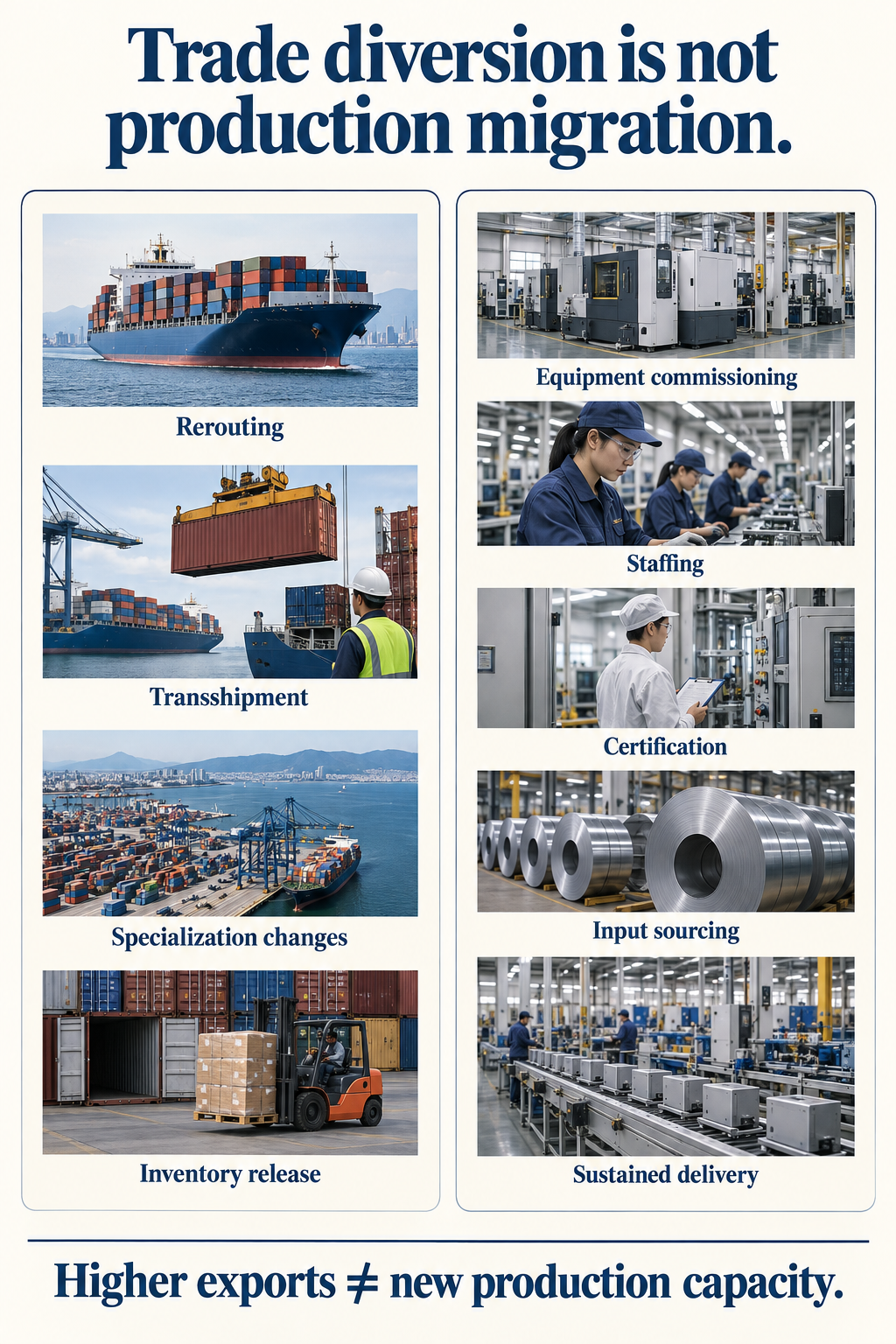
Exports from one economy to a market may rise because of new production, rerouting of existing products, changes in firm-level specialization, transshipment, or inventory release. To establish genuine new supply capacity, analysts should look for equipment commissioning, staffing, certification, input sourcing, origin compliance, and sustained delivery—not export value alone.
If exports rise without corresponding evidence of production expansion, the production-migration interpretation should remain open. If the increase is mainly a price effect, it cannot be treated as proof of greater physical demand. The current summary does not provide a product, region, or company mapping. Trade diversion is therefore an analytical question to decompose, not a confirmed source of corporate growth.
7. Orders can move before underlying demand
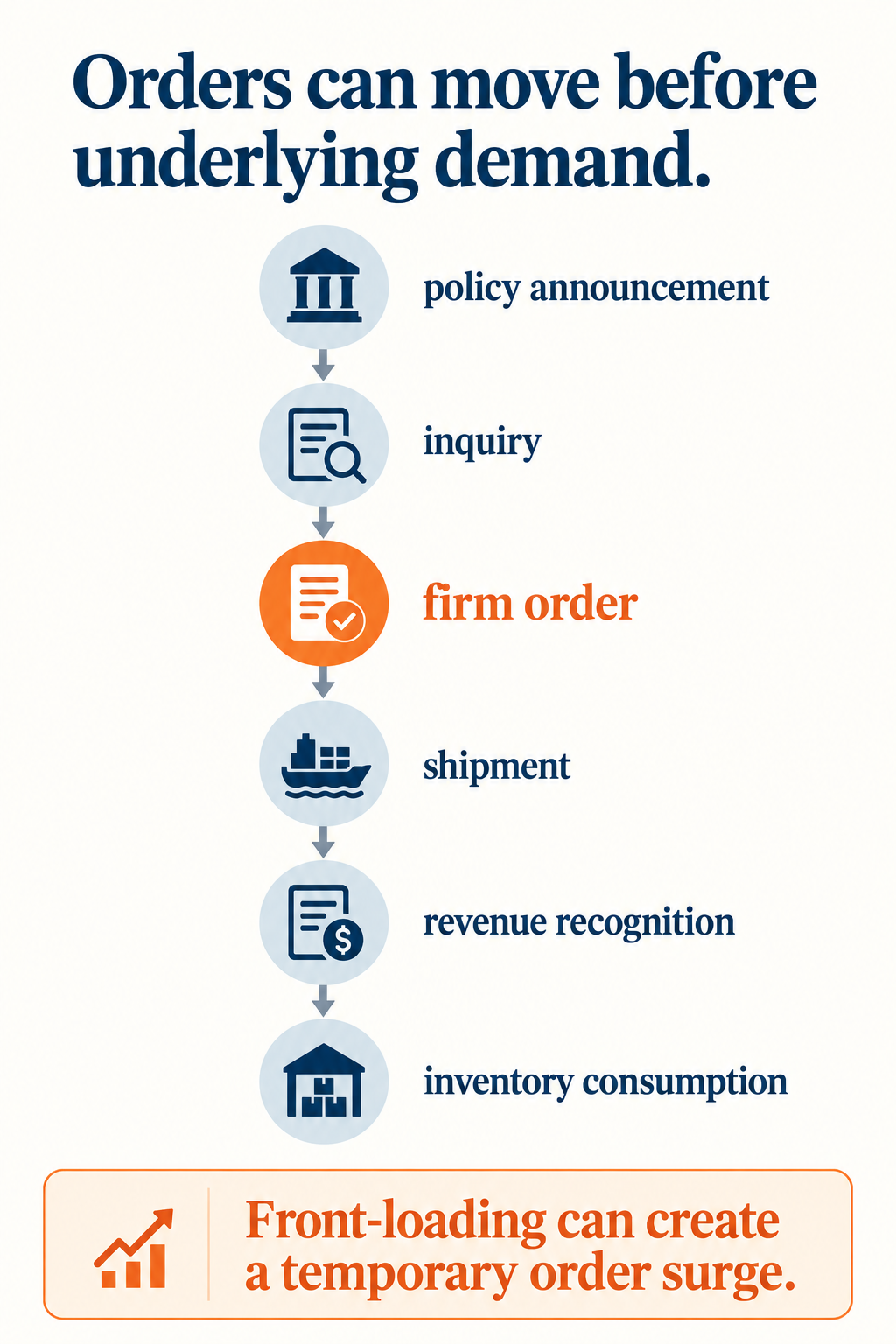
Policy announcements, effective dates, customer orders, shipments, revenue recognition, and end use occur at different points in time. Customers may build inventory ahead of expected restrictions, creating a temporary order surge followed by a pullback. They may also wait for rules to become clear, delaying purchases without eliminating long-term demand.
A careful study separates inquiries, expressions of interest, firm orders, physical delivery, and recognized revenue. Each is a different level of evidence. A one-month export increase, a longer lead time, or a company report that inquiries have increased cannot independently prove durable demand improvement.
More informative observations include whether orders convert into deliveries, whether inventory is consumed, whether customers reorder, whether price concessions widen, and whether later revenue follows the shipment pattern. The three source summaries contain no company-level order, inventory, or delivery records. We therefore cannot describe inventory front-loading, order diversion, or a purchasing freeze as an established effect of this policy.
8. Bargaining power determines profit transmission
Revenue growth is not the same as profit improvement. A company may raise prices and lose demand, or win more orders while absorbing additional freight, certification, equipment, compliance, and financing costs.
Operating analysis should examine unit revenue, procurement expense, volume, mix, and period costs together. High customer concentration and abundant substitutes can weaken a firm’s ability to pass through costs. Differentiated products and scarce delivery capacity can make price adjustment easier. These are conditional predictions, not substitutes for company disclosure.
A higher gross margin may instead reflect currency movements, lower raw-material prices, or a richer product mix. Higher revenue may reflect price inflation rather than greater physical output. This article contains no company financial filings or operating data and therefore makes no definitive claim about any company’s earnings direction.
9. Different restrictions require different models
Tariffs primarily alter choices through prices and payment obligations. Other trade restrictions may affect market access, licensing, delivery eligibility, or documentation requirements directly. The legal nature of the measure should be identified before its economic mechanism is modeled.
For a licensing restriction, the key questions may be whether approval is available and how long it takes. For an origin-documentation rule, the key question may be whether the supply chain can produce sufficient evidence. For an import prohibition, a higher price may not solve the delivery problem at all.
The USTR source title refers to a forced-labor-related investigation, but the available summary does not establish the exact instrument used in the final action or the obligations imposed on every company. Rates, exemptions, filing requirements, and enforcement examples from other policies must not be imported into this case without evidence.
10. Sector growth may have another cause
The WTO outlook summary also discusses AI-related goods. This is a reminder to separate trade-policy effects from demand-structure effects. If demand for a product class is expanding because of technology adoption, exports or orders may rise even while a trade restriction is operating. Conversely, weak end demand may conceal a supplier’s gains from substitution.
The forces can coexist. Aggregate growth alone cannot identify one as the dominant cause. If similar growth appears in products or regions outside the policy’s coverage, the demand explanation becomes more important. If changes appear only in covered products, the policy explanation gains support, but legal coverage, timing, and commercial transmission still need to be established.
The current summary does not confirm overlap between AI-related goods and the products covered by the Section 301 action. No direct causal link can therefore be claimed. Without product-level coverage, demand indicators, and comparable samples, the independent contribution of the tariff remains unidentified.
11. Local gains do not prove economy-wide improvement
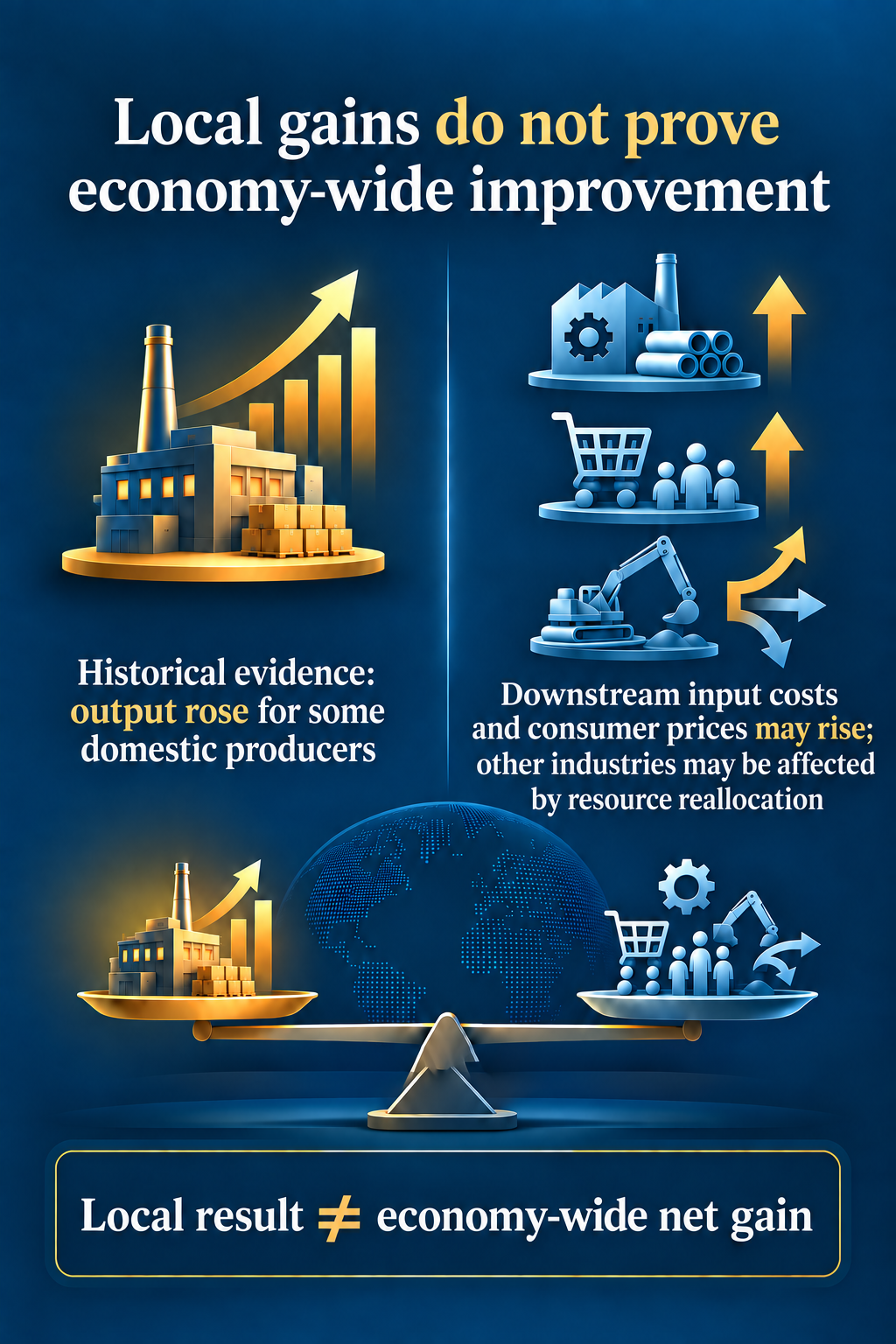
The USITC summary explicitly warns that the historical results do not establish a net gain for the whole economy. This limitation belongs at the center of the conclusion.
When some domestic producers receive more orders, downstream users may face higher input costs, consumers may face higher prices, and other industries may experience resource reallocation. Local output, company profit, industry competitiveness, and economy-wide welfare are different questions requiring different evidence.
Selecting only expanding producers creates a sample-selection problem. Looking only at price increases can also miss supply adjustment. The available summaries are insufficient for a complete welfare analysis or for measuring the combined trade-offs among supply security, enforcement burden, and other policy objectives.
12. State the thesis so that evidence can overturn it
A company-benefit thesis requires several connected conditions: the relevant product must be covered; customers must have a reason to switch; the company’s product must satisfy technical and compliance requirements; the company must be able to deliver; and incremental revenue must not be fully offset by operating costs.
A testable conditional proposition is: if the policy covers the product, customers have switching incentives, and alternative supply can actually deliver, order allocation may change. That is a hypothesis, not an observed event.
The conclusion should be narrowed or withdrawn if the product is excluded, implementation is delayed, an exemption removes practical exposure, or replacement suppliers cannot satisfy certification, origin, or delivery requirements. An order increase accompanied by inventory accumulation, cancellations, or price concessions would also challenge the interpretation of durable operating improvement. A major shift in end demand could provide a stronger explanation for the observed change.
13. Conclusion and evidence still needed
The most defensible conclusion has three parts. First, historical research supports the possibility that tariffs change affected imports, some domestic prices, and some domestic output; it does not support a claim of economy-wide net benefit. Second, the policy-action summary confirms a final action but is insufficient to determine product- or company-level legal exposure. Third, the global trade outlook provides context on trade diversion and AI-related goods but cannot prove that any company has won incremental orders.
Business outcomes emerge from the interaction of legal coverage, burden sharing, substitution capacity, procurement timing, and demand conditions. Each link needs independent evidence. The materials most likely to improve the analysis are the complete policy text and annexes, implementation guidance, product-to-origin mapping, and public company evidence on orders, inventory, delivery, and profit.
Until those materials are available, the direction and magnitude of company impact should remain uncertain. Historical association should not be upgraded into causal proof of the 2026 action. Unobserved operating changes should not be written as realized outcomes. For investment research, the first task is not to name a beneficiary. It is to identify which link in the transmission chain is evidenced and which link is still missing.
Further reading:
- Trade policy and corporate transmission mechanisms
- Trade diversion, supply-chain substitution, and production migration
- Identifying orders, inventory, and profit effects after policy shocks
Sources:
- https://www.ustr.gov/about/policy-offices/press-office/press-releases/2026/july/ustr-takes-action-forced-labor-section-301-investigations
- https://www.usitc.gov/press_room/news_release/2023/er0315_63679.htm
- https://www.wto.org/english/res_e/booksp_e/gtos0326_e.pdf
Apply the transmission chain to a specific policy or company: verify legal coverage first, then collect evidence on contracts, procurement, delivery, inventory, and profit while keeping unsupported links explicitly unknown.
This article relies on verified summaries and stated scopes of public materials from the United States Trade Representative, the United States International Trade Commission, and the World Trade Organization. The available USTR summary does not fully provide the final instrument, covered products, rates, effective dates, exclusions, or enforcement guidance. The article does not reproduce unverified product estimates, methods, forecast figures, or uncertainty ranges from the USITC or WTO materials. The underlying webpages and PDF were not independently reopened for this article, so the summaries should not be treated as the complete policy text, annexes, or implementation instructions. No company-specific filings, contracts, import records, orders, inventory, delivery, or margin data were provided. Mechanisms, counterevidence, and transfer conditions are analytical frameworks, not claims that a particular company has experienced a realized outcome.