
What judgment does this research establish, and what evidence would invalidate it?
An AI Boom Is Not an Investment Thesis: Following the Cash Through the Infrastructure Stack
A company appears on a list of potential AI beneficiaries. Its products seem relevant. The industry narrative is compelling. A presentation connects the company to a large pool of prospective spending.
What, exactly, has been established?
Possibly that the business deserves investigation. Not necessarily that it will win customers, earn attractive margins, collect its receivables, or offer a sensible investment at the prevailing price.
The difficulty is not a shortage of information. It is the tendency to let evidence supporting one proposition stand in for evidence supporting several others. A customer’s expansion plan becomes a supplier’s order. An order becomes revenue. Revenue becomes cash generation. A credible business becomes an attractive security.
This essay offers a way to slow that chain of inference down. It is an analytical framework, not a finding about the current state of the AI industry. It contains no company recommendations, current financial estimates, or claims of investment outperformance. The aim is to make thematic research more explicit about what it knows, what it assumes, and what would change its mind.
Start with the invoice, not the beneficiary list
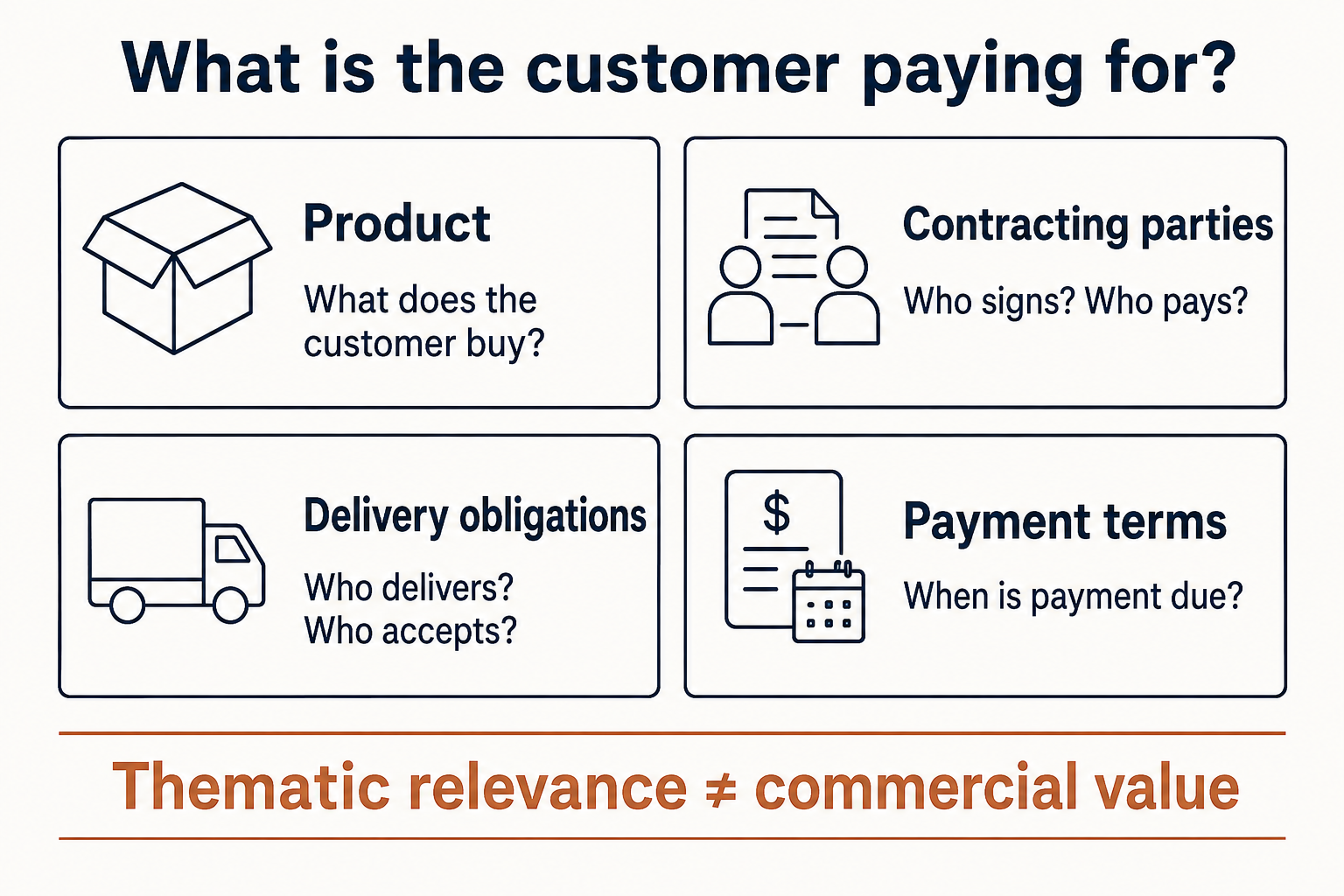
A useful opening question is surprisingly mundane: what would the customer actually pay this company for?
Try to describe the transaction without using the words “AI exposure.” Name the product or service, the contracting parties, the delivery responsibility, and the conditions under which payment becomes due. If those details remain unclear, the investment narrative may be running ahead of the commercial evidence.
Consider the difference between supplying a component, integrating a system, conducting a customer trial, and distributing another company’s equipment. All could place a business somewhere near an important project. They do not establish the same role or the same opportunity to retain economic value.
This is not an argument that one role is invariably superior. It is a request to investigate the role before assigning it an attractive economics story. A technically demanding product might carry substantial development obligations. A less visible service might have a different contracting structure. Neither conclusion can be read from a theme label.
When customer information is confidential, do not guess the customer’s identity to make the narrative feel complete. State which commercial relationship can be documented and which remains unresolved. A missing piece of evidence is a limit on the conclusion, not an invitation to finish the story.
Ask where the opportunity could break
An industry thesis usually begins with a reason for spending to rise. Company research needs a second question: where might the connection between that spending and this supplier fail?
The following are questions to investigate, not assertions about any particular market. Does the product require qualification? Is the supplier eligible to serve the intended customer and geography? Does delivery depend on another part of the project? Is funding committed? Could the buyer use another supplier or a different technical approach?
Each answer identifies a condition that the investment narrative is relying on.
A bottleneck can be commercially important without belonging to every business mentioned alongside it. A proposed solution can be technically plausible without being available for commercial deployment. A large project can include many suppliers while leaving the value attributable to any one of them uncertain.
The practical discipline is to write down the dependency chain before assigning confidence. “Customers need more capacity” may be a reasonable starting hypothesis. “This company will generate durable cash from that need” requires additional propositions about access, execution, bargaining position, and costs.
Keeping those propositions separate makes disagreement productive. Another analyst can challenge the customer-access assumption without having to reject the entire industry thesis.
Treat commercial milestones as distinct claims
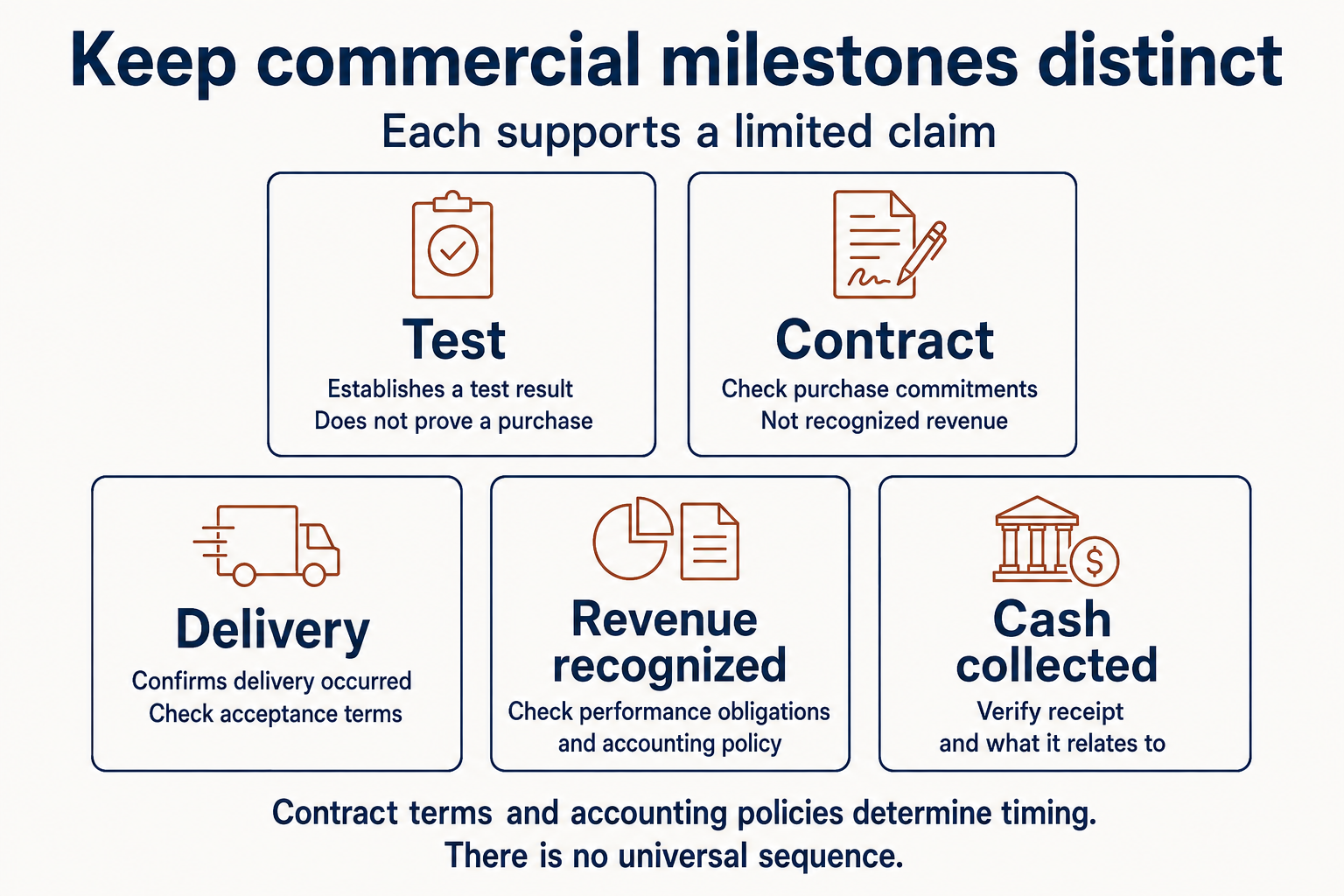
Research becomes less reliable when terms such as partnership, qualification, contract, backlog, shipment, and revenue are used interchangeably.
For each announcement, ask for the narrowest claim it can support. A successful test can support a statement about that test. A framework agreement may require further investigation into actual purchase commitments. A shipment may still leave questions about acceptance, contractual obligations, and accounting treatment.
Under IFRS 15, revenue recognition is tied to satisfying performance obligations through the transfer of promised goods or services. The relevant accounting policy and contract terms matter; a commercial announcement is not, by itself, a revenue-recognition conclusion. [IFRS Foundation: Revenue from Contracts with Customers](https://www.ifrs.org/issued-standards/list-of-standards/ifrs-15-revenue-from-contracts-with-customers/)
Do not turn this into a rigid timeline imposed on every business. Some arrangements involve advance payments; others involve performance over time or several distinct obligations. The objective is not to make every company fit the same diagram. It is to stop differently defined milestones from being compared as if they were identical.
A useful research table preserves the issuer’s terminology, the measurement date, and the unresolved condition. If two sources define a metric differently, keep both definitions visible. Combining them into one apparently clean number can remove the very distinction the reader needs.
Find out how much of the business the theme actually explains
Suppose the commercial relationship is credible. The next question is materiality.
Which part of the company participates in the activity? How much of the available operating information relates to that part? Are the products grouped with other businesses in reporting? Can changes in the company’s overall results reasonably be attributed to the activity under discussion?
The absence of a segment breakdown should not be treated as evidence that the opportunity is either enormous or negligible. It means the scale of the exposure is unresolved. The appropriate response is a narrower conclusion.
This is also the point to distinguish participation from value capture. Investigate the costs and responsibilities attached to the business: development, production, installation, warranty, support, and any other obligations established by the available evidence. Ask whether the optimistic narrative accounts for them.
Revenue, expenses, and profit represent different parts of operating performance. The SEC’s introductory financial-statement guide is useful precisely because it encourages readers to connect the statements rather than infer the whole business from a single headline figure. [SEC: Beginners’ Guide to Financial Statements](https://www.sec.gov/about/reports-publications/beginners-guide-financial-statements)
An effective editorial test is to remove the theme name from the draft. Does a coherent business case remain—one expressed through customers, products, costs, and operating outcomes? If the argument loses most of its force without the fashionable label, it probably needs more company-specific work.
Investigate cash conversion without jumping to a verdict
A gap between reported profit and cash generation is a research question, not a complete diagnosis.
Cash-flow reporting distinguishes operating, investing, and financing activities. Under the indirect method, the reconciliation adjusts profit for non-cash effects and timing differences in operating receipts and payments. That accounting distinction explains why profit and cash need not move together; it does not decide whether a particular company is healthy. [IFRS Foundation: Statement of Cash Flows](https://www.ifrs.org/issued-standards/list-of-standards/ias-7-statement-of-cash-flows/)
When receivables rise or operating cash weakens, write competing explanations before choosing one. Expansion, collection terms, period-end timing, and deterioration in customer payments are possibilities to investigate—not interchangeable conclusions. What disclosures would help distinguish them? What subsequent evidence would make the initial explanation less credible?
Apply the same discipline to inventory. Do not automatically describe an increase as either preparation for growth or proof that demand has failed. Examine its composition, relationship to documented orders, and the issuer’s disclosures. For IFRS reporters, inventory measurement includes a constraint based on the lower of cost and net realisable value; inventory on the balance sheet is not a promise of future sales at the desired price. [IFRS Foundation: Inventories](https://www.ifrs.org/issued-standards/list-of-standards/ias-2-inventories/)
The important output is a testable follow-up. Identify what the next useful disclosure could establish about delivery, collections, inventory quality, or the explanation previously offered. If the information never arrives, the unresolved question should remain in the record. Fluent prose is not a substitute for resolution.
Make the price assumptions visible
Even a persuasive business case leaves an additional question: what has to happen for the price under consideration to make sense?
This framework does not assume that an analyst can observe market expectations precisely. Instead, it asks the analyst to disclose the assumptions in their own valuation reasoning. How much growth is required? For how long? What operating economics, reinvestment needs, and competitive conditions must accompany it?
Keep three categories distinct: results already reported, expectations stated by management, and the analyst’s own projections. When all three appear in one paragraph without labels, forecasts can borrow the authority of historical facts.
The same caution applies to references to consensus estimates. Before calling a result a beat or a miss, check the date, sample, reporting period, and accounting basis of the comparison. If those details are unavailable or inconsistent, the strength of the statement should fall accordingly.
A price movement cannot fill the missing fields. Nor does a subsequent rise establish that the original investment reasoning was sound. This essay supplies no event study linking operating announcements to security returns.
The practical exercise is scenario-based: identify which assumptions do most of the work and show what would happen to the argument if they changed. This is more informative than presenting a confident conclusion whose dependence on several favourable conditions remains hidden.
Use a hypothetical comparison to expose missing evidence
Consider two entirely fictional suppliers. These are teaching examples, not disguised descriptions of real companies.
Supplier A announces that a product has completed a customer test. The available material does not establish purchase commitments, the commercial terms, or the economics of production.
Supplier B discloses product deliveries, but the available information leaves collection quality unresolved. The commercial evidence is closer to operating results, yet the cash implications still require investigation.
There is no justified winner in this comparison. Supplier A needs evidence connecting technical progress to a commercial relationship. Supplier B needs evidence clarifying the economic quality of a relationship that appears further developed. Both remain research candidates, but they are not missing the same thing.
Now imagine a report describing both as “well positioned for AI demand.” The sentence may sound reasonable while concealing almost everything an investment researcher needs to know.
A better report states the particular proposition supported for each supplier and the next observation that could alter it. The lesson is not to prefer caution in every case. It is to prevent confidence gained on one dimension from spreading automatically to dimensions that have not been examined.
Build a memo that can disagree with its earlier self
Research should leave a record that can be tested later.
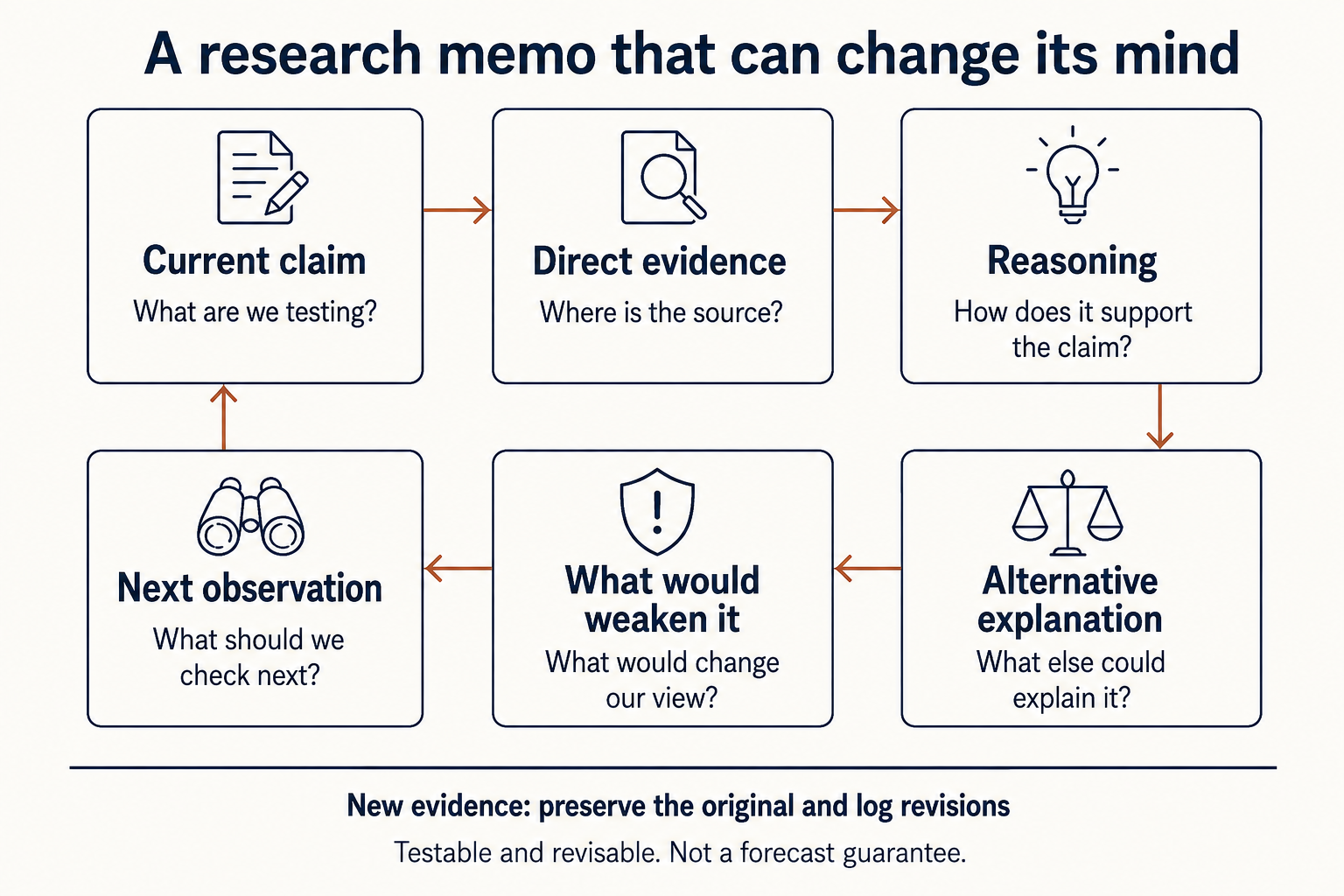
A compact memo can do this with six elements: the present claim, the direct evidence, the inference connecting them, a competing explanation, a condition that would weaken the claim, and the next useful observation.
The claim should be narrower than “the long-term outlook is attractive.” It should identify the customer need, commercial relationship, or operating development being investigated. Evidence should retain its publisher, date, reporting period, and location. A media report and an issuer filing can both be useful without being treated as identical sources.
The competing explanation is especially important. If the preferred view interprets inventory as preparation for growth, what would support a less favourable explanation? Conversely, if the preferred view is negative, what evidence would demonstrate that the pressure was temporary? The standard should not depend on which answer the analyst wants.
Preserve the original memo when new information arrives. Add a revision explaining what changed instead of quietly rewriting the initial claim. Otherwise, the record may gradually turn into a story in which every outcome was anticipated.
A well-maintained memo is not proof of forecasting skill. It is the prerequisite for evaluating that skill honestly.
Check whether different companies share the same untested premise
A list covering computing, connectivity, power, and cooling can appear broad. Yet the research behind every name might depend on the same expansion plan, budget assumption, or technical pathway.
This is a check on the argument’s structure, not a measurement of actual portfolio correlations. Ask which conclusions would need to be revisited together if a common premise failed. Also identify where genuinely separate customer or operating evidence supports a conclusion.
Security selection and portfolio decisions remain distinct. Investor.gov notes that allocation depends on factors such as time horizon and risk tolerance, and that a narrowly focused fund does not necessarily provide adequate diversification. [Investor.gov: Asset Allocation and Diversification](https://www.investor.gov/introduction-investing/getting-started/asset-allocation)
For a research process, the immediate benefit is better use of attention. Ten reports repeating one industry forecast do not supply ten independent pieces of evidence. Identifying shared dependencies makes it easier to decide what new information would actually improve the analysis.
It also makes the archive more useful. When a core premise changes, the researcher can find the affected arguments rather than waiting for inconsistencies to surface one article at a time.
Finish the research without pretending to finish the uncertainty
A research assignment can be complete while important questions remain open. Completion means the question is defined, the evidence is traceable, the reasoning is explicit, and the reader understands what future information could change the conclusion.
It does not mean that a business has been fully explained or that an investment outcome has been demonstrated.
The framework offered here asks analysts to connect an industry narrative to customer relationships, delivery obligations, business materiality, operating economics, and cash quality. Each connection must earn its own evidential support. None should inherit certainty merely because the preceding connection looks plausible.
The framework itself has not been validated through a forecasting study, an investment backtest, or a cross-cycle performance assessment. If it is used to build a case library, the original claim, information cutoff, later observations, and revisions should be preserved. A favourable outcome in one case would still not establish general effectiveness.
The goal is not to end every industry discussion with a stock idea. It is to ensure that every specific conclusion can be traced back to evidence strong enough to support it—and no further.
Sources, provenance, and limits
The questions in this essay were developed from earlier research notes about the gap between thematic relevance, company-level evidence, and operating quality. Private financial information, internal operational records, named-company figures, and market claims not rechecked for this edition have been excluded.
The linked IFRS Foundation, SEC, and Investor.gov materials support limited accounting concepts and basic risk boundaries. They do not endorse this framework. Analysis of an actual issuer must use its applicable accounting standards, formal disclosures, and contractual facts.
The research workflow, memo design, and fictional supplier comparison are the author’s analytical proposals. No customer interviews, industry sampling, investment performance, or empirical calibration results are presented. This essay is intended for research education, not personalised investment advice.
Take an existing sector memo and identify the direct evidence, unresolved assumptions, and next useful observation for each claim.
This is an analytical framework, not a finding about current industry conditions, a security recommendation, or evidence of investment outperformance. No backtest or out-of-sample validation is presented.