
What judgment does this research establish, and what evidence would invalidate it?
The research question and the narrowest defensible conclusion
Large data centers and industrial facilities are often discussed through a compressed narrative: electricity demand is rising, interconnection policy is improving, projects will connect faster, and the companies involved will earn more. That narrative combines several distinct events. A policy can change without a project receiving service. A project can receive an interconnection arrangement without operating at its planned scale. A facility can operate without generating the expected revenue. Revenue can rise without profit improving.
The narrowest conclusion supported by the materials reviewed here is that the U.S. Federal Energy Regulatory Commission (FERC) has taken regulatory action concerning the interconnection of large loads and has asked six regional grid operators to explain or reform relevant rules. This establishes that large-load interconnection is a clear regulatory issue. It does not establish that any particular data center or industrial project has received permission to connect, begun stable power consumption, or produced higher profits as a result.
The analytical discipline is therefore sequential: institutional change, project interconnection, physical operation, commercial performance, and profit realization must be tested separately. A positive signal at one level cannot be promoted into a conclusion at the next level without new evidence.
What the FERC signal does and does not establish
The source material includes two dated FERC summaries. One concerns a large-load interconnection announcement dated April 16, 2026. Another concerns a targeted action dated June 18, 2026, whose summary states that FERC asked six regional grid operators to explain or reform large-load interconnection rules. The materials also identify the RM26-4 docket and the EL26-67-000 order PDF as formal sources.
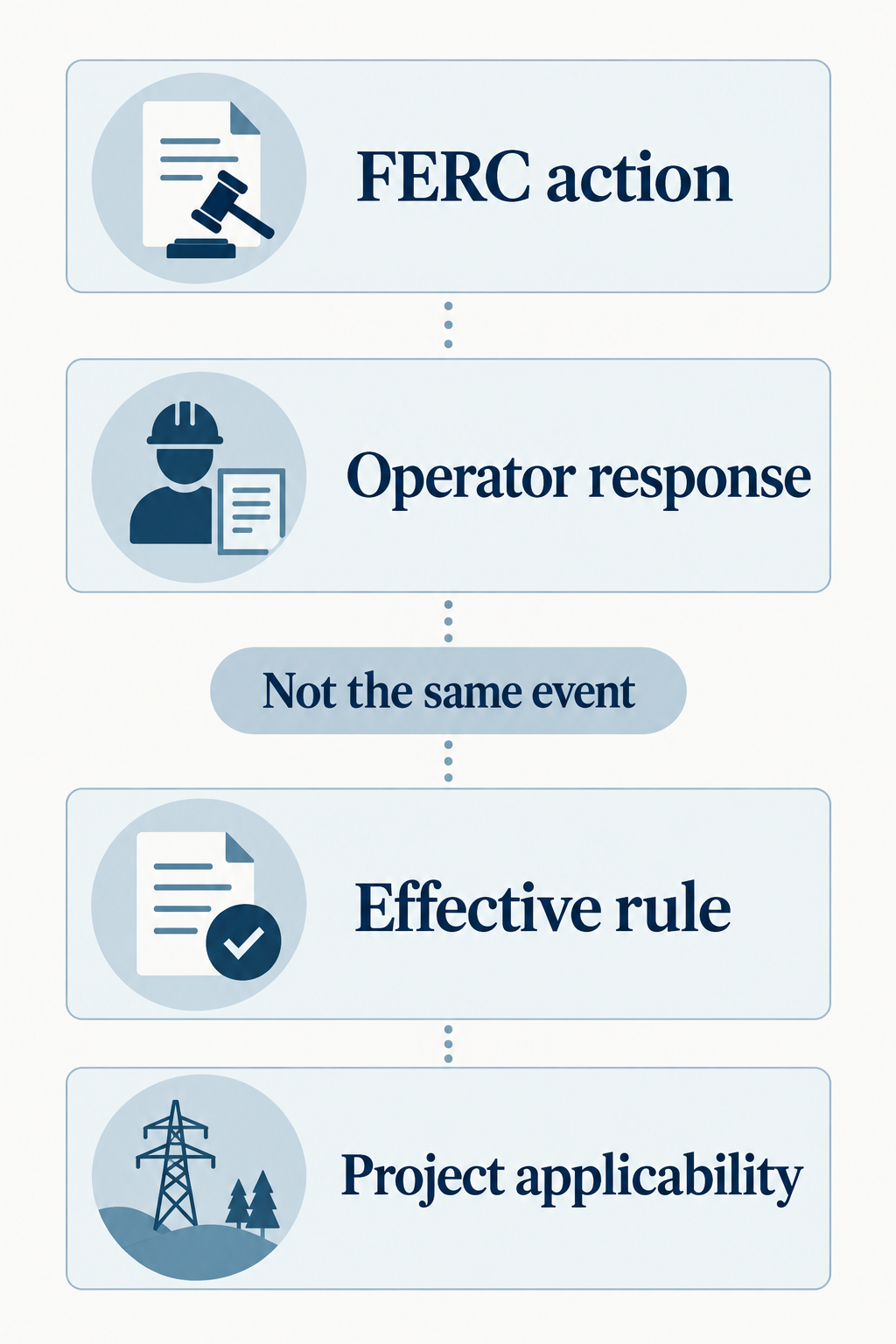
These sources support a timeline of regulatory attention. They do not show that every procedural step has been completed. A regulator asking questions, an operator submitting a response, a rule being approved, and a new rule applying to a specific project are different events. The language of an initiative cannot by itself demonstrate that interconnection conditions have broadly loosened.
The six operators may face different network structures, supply conditions, existing queues, and project mixes. The available summaries do not establish their individual responses, eligibility thresholds, procedural deadlines, exceptions, or effective dates. Those details remain unknown and matter for any regional or project-level conclusion.
Institutional constraints are different from physical constraints
A facility may have a site, buildings, equipment, and an expansion plan while still lacking the conditions required for sustained electricity use. At least two constraint layers should be separated.
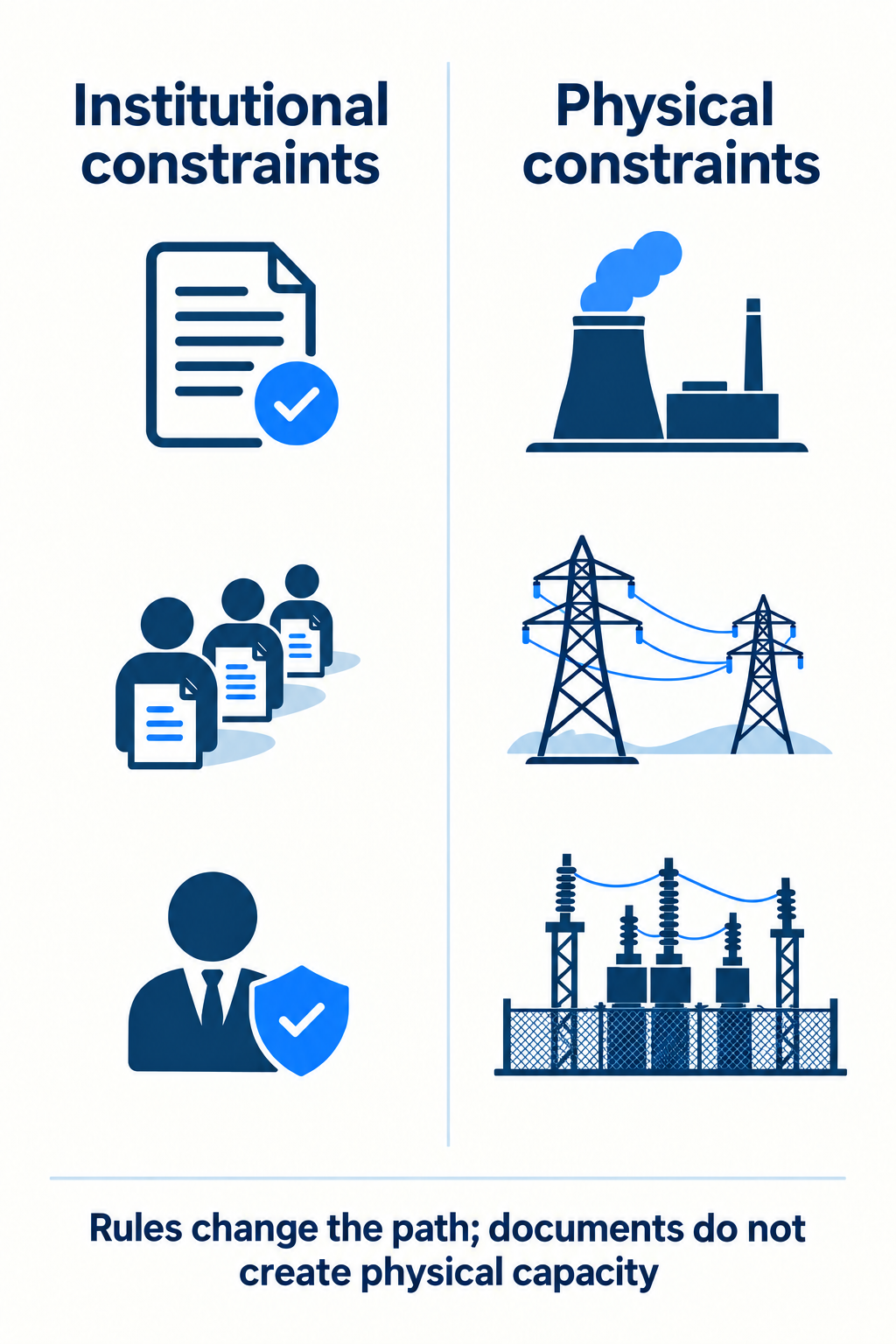
Institutional constraints concern eligibility, application requirements, queue treatment, cost allocation, responsibility for network upgrades, and operating conditions. Policy reform can make these factors clearer. It may reduce repeated review, define responsibilities, or provide an earlier answer about whether a proposal can proceed.
Physical constraints concern generation availability, transmission capacity, local equipment, and system conditions at the times when the load is needed. A regulatory document does not automatically create a substation, transmission line, generation resource, or operating reserve. Policy can change how a project confronts a physical constraint, but it cannot create physical capability merely by changing paperwork.
The relative importance of these layers is project-specific. If a region has sufficient capacity and a project is mainly delayed by land, equipment, construction permits, customer demand, or financing, a change in interconnection procedure may have limited effect on its schedule. The available materials do not provide regional reserve data or a project-specific constraint ranking, so electricity cannot be assumed to be the primary bottleneck for every expansion project.
Faster processing is not the same as more capacity
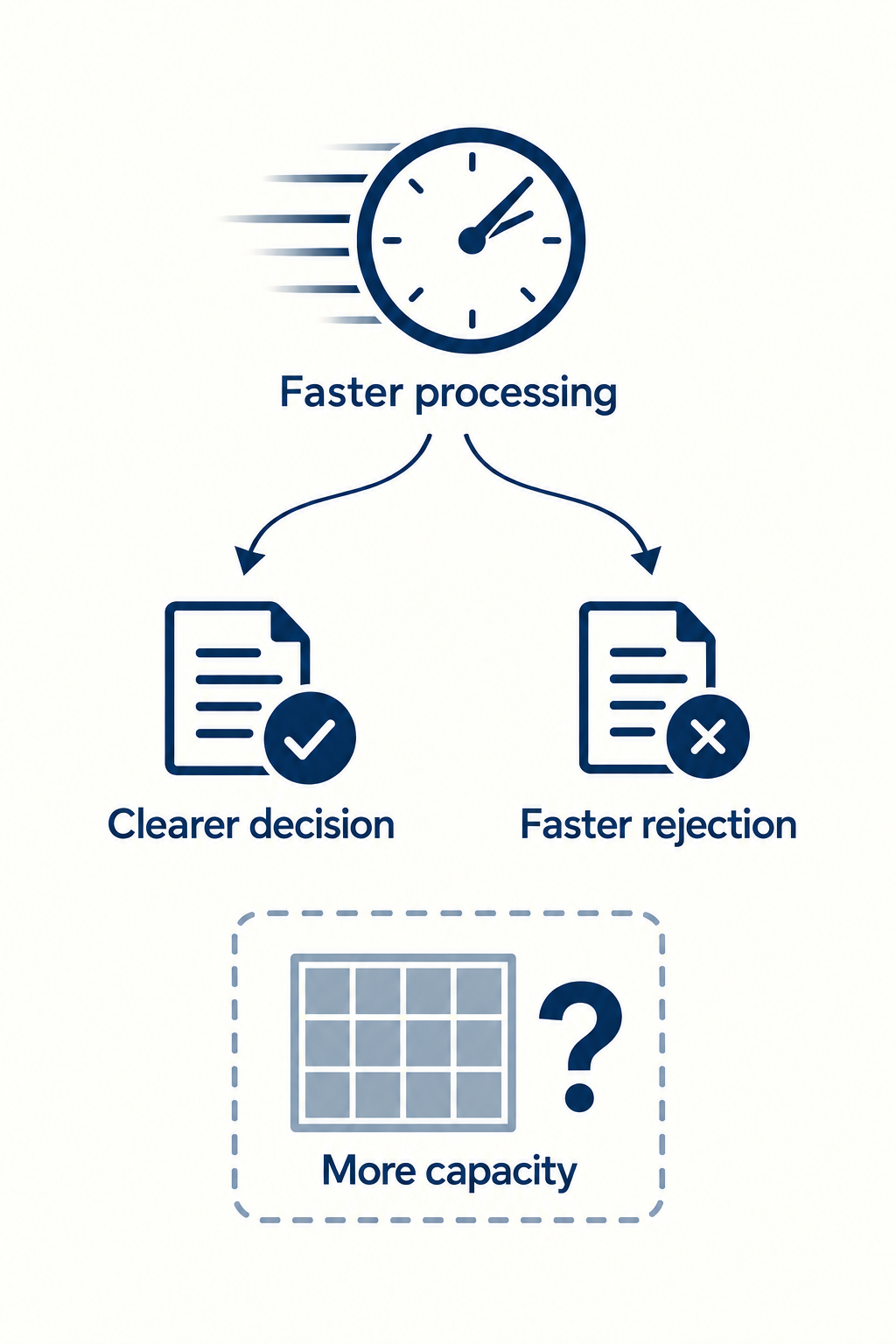
The immediate value of interconnection reform may be faster decision-making and clearer information rather than additional megawatts. Fewer duplicative reviews, clearer application materials, and better allocation of responsibilities could help a developer learn earlier whether a proposal is feasible.
But faster rejection is also faster processing. A clearer rule may impose more explicit requirements on project readiness, cost responsibility, or technical performance. Some proposals could be reduced, delayed, or withdrawn. The system could become more transparent without becoming uniformly more permissive.
A meaningful evaluation would require before-and-after evidence on processing time, application volume, approved volume, approved capacity, and actual energization. It would also require separating requested capacity, approved capacity, capacity ready for interconnection, and capacity that is operating continuously. Without those observations, a regulatory announcement cannot support an estimate of new load or a claim that efficiency has improved in practice.
Large loads are not a single operating category
Data centers and industrial facilities may both be classified as large loads, but their operational requirements can differ substantially. The relevant questions include whether demand is continuous, whether load can be added in phases, whether short interruptions or curtailment are acceptable, and how restrictions affect output or service commitments.
Some computing workloads may have scheduling flexibility, but that does not mean every data center can reduce demand at will. A service with strict latency, availability, or redundancy commitments may treat a short restriction very differently from a batch workload. Industrial facilities also vary: some processes may have storage or scheduling flexibility, while others depend heavily on continuous operation. The label “industrial” does not prove either complete inflexibility or easy adjustability.
The practical value of an interconnection arrangement should therefore be assessed by when power is available, what triggers a restriction, how long it can last, whether construction can be phased, and whether the arrangement matches the facility’s output requirements. The source material contains no company-specific technical conditions or operating commitments, so it cannot identify which project type would benefit most from conditional access.
Conditional access needs its own evidence
The statement that a project has connected does not necessarily mean that it has obtained the full, unrestricted supply required by its original plan. Analysts should identify whether the arrangement meets expected operating requirements or is conditional on time of day, network state, dispatch instructions, reliability conditions, or other restrictions.
A project might begin earlier by accepting limits. That could improve the connection date while leaving sustainable utilization, service reliability, and future expansion uncertain. Conversely, a stricter arrangement might delay the start date but better match the project’s actual operating needs. Comparing only connection dates can make unlike projects appear equally mature.
The same caution applies to announcements, permits, and agreements. Each represents a different stage. A clear project-level conclusion requires evidence about the applicable interconnection terms, engineering milestones, equipment readiness, validation, and actual or sustained load. The current materials provide no project-specific supply conditions, so they do not show whether the FERC action traded reliability for speed.
Project conversion requires a chain of observations
A project should be tracked through a sequence rather than represented by one headline number. Relevant stages may include an application, technical review, responsibility negotiations, an agreement, network construction, equipment preparation, site validation, and a gradual increase in load. The exact legal order may differ by jurisdiction; this is an analytical checklist, not a claim about every region.
Requested capacity indicates an intention or proposal. Approved capacity indicates a regulatory or procedural outcome. Capacity ready for interconnection is a readiness state beyond procedural approval. Stable operation still requires evidence that the facility is actually consuming power and operating over time. These states cannot be substituted for one another.
Interconnection rules may also influence site selection and phasing. A region with clearer procedures could attract projects seeking earlier certainty, but location decisions also depend on customers, communications, logistics, water, labor, and other permits. An increase in applications may represent real migration, multiple contingency sites, or speculative queue positions. The source material includes no records of migration, duplicate applications, or withdrawals, so it cannot determine whether policy changes altered real construction choices or mainly changed early-stage behavior.
From operation to profit: five gates
Even when a facility is connected and operating, electricity is only one necessary condition. Profit depends on utilization, customer or product demand, revenue recognition, depreciation, interest, maintenance, network-upgrade costs, and other operating expenses.
The transmission path also differs by business model. A facility owner must show that improved operating conditions lead to utilization, customer revenue, or product output. A regulated grid-related company requires evidence about the permitted revenue mechanism, cost recovery, and returns on capital spending. An equipment supplier requires actual orders, delivery, acceptance, and collection. A policy signal is not a substitute for any of these records.
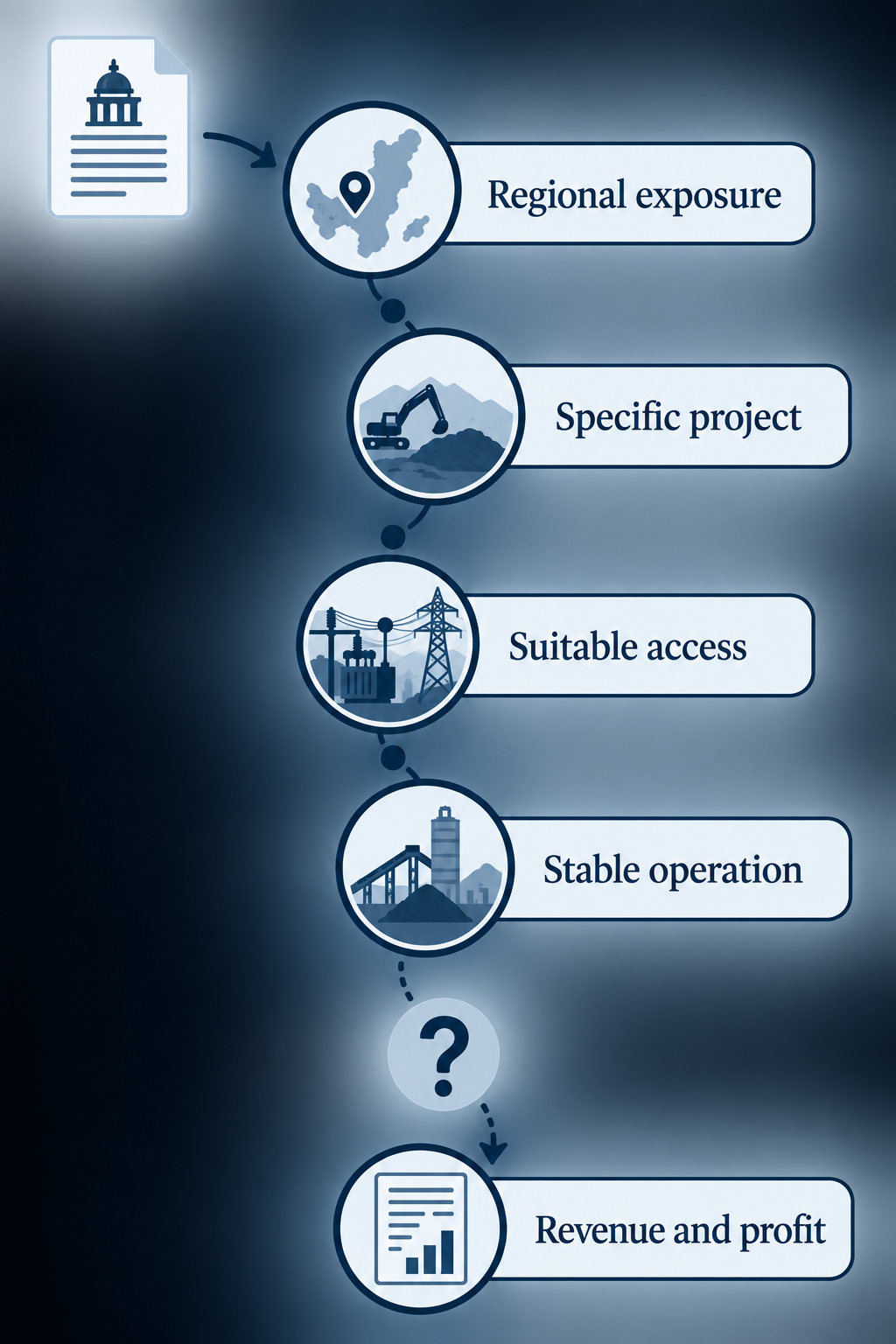
A practical five-gate test is: first, is the company exposed to the relevant region and rule? Second, does it have a specific project or order? Third, does the project have access that matches its operating needs? Fourth, is it operating steadily at a meaningful level? Fifth, do disclosed revenues translate into improved profit after capital and operating costs? No current company filings, project disclosures, or financial evidence were provided here, so no company-benefit conclusion is warranted.
Counterexamples and reverse effects
There are at least three important counterexamples to a simple expansion thesis.
First, processing can accelerate while physical network work remains incomplete. A project may receive an answer sooner without receiving usable power sooner.
Second, clearer rules can reduce activity. If a proposal depended on ambiguous eligibility or an uncertain allocation of network responsibility, explicit requirements could lead to downsizing, delay, or withdrawal. Better screening may improve system allocation while reducing near-term application counts.
Third, observed project operation may be caused by something else. Demand growth, completion of pre-existing construction, equipment availability, or local permitting could coincide with regulatory action. If regions unaffected by the relevant rule show similar improvement, the policy’s independent explanatory power must be reconsidered.
These are competing explanations and conditions for falsification, not observed outcomes in the supplied evidence. Keeping them visible prevents the analysis from selecting only the path that supports an expansion narrative.
Transfer conditions across regions, countries, and sectors
The fact that six regional operators are involved does not imply identical supply conditions, network structures, rules, or implementation schedules. Before transferring a conclusion from one region to another, an analyst should verify comparable rules, comparable project stages, comparable reliability requirements, and whether the binding constraint is procedural or physical.
Across countries, transferable questions include who decides interconnection, who pays for network construction, how applications are prioritized, how operating restrictions are defined, and how actual supply is demonstrated. FERC’s specific jurisdiction, operator obligations, procedures, and revenue mechanisms are not automatically transferable.
Across sectors, the mechanism must also be rebuilt. Data centers and industrial facilities may both require substantial electricity, but their load shape, construction cycle, flexibility, reliability requirements, and revenue realization differ. A shared category does not establish a shared commercial outcome.
A record for evidence and recalibration
Researchers can use the following blank fields to keep the layers distinct:
Research question: ____________________________ Evidence of institutional change: ______________ Formal operator response: _____________________ Specific project and region: ____________________ Requested capacity: ___________________________ Approved capacity: ____________________________ Capacity ready for interconnection: _______ Evidence of stable operation: __________________ Supply limits and reliability terms: ____________ Revenue evidence: _____________________________ Profit evidence: _______________________________ Main counterevidence: _________________________ Condition that would change the conclusion: _____
Each entry should preserve whether it is a fact, user evidence, inference, hypothesis, or unknown, along with its source. There is no pre-registered forecast record in the materials reviewed here, so this article does not claim that a forecast calibration has been performed. It also provides no personal position, trading signal, or trading instruction.
Final judgment and what would change it
The evidence supports a limited but useful conclusion: FERC has made large-load interconnection a concrete regulatory issue and has asked six regional grid operators to explain or reform relevant rules. This may change application procedures and responsibility boundaries for data-center and industrial projects. It has not yet demonstrated how the rules will take effect, whether a specific project will energize earlier, or whether any company’s profit will improve.
Formal operator responses and effective rules would move the analysis to institutional implementation. Project-level interconnection terms, engineering milestones, and stable-operation disclosures would be needed to assess conversion into physical operations. Company operating and financial evidence would be needed before discussing profit transmission. Contrary evidence at any stage should narrow the corresponding conclusion.
Sources: FERC, April 16, 2026: https://www.ferc.gov/news-events/news/ferc-act-large-load-interconnection-docket-june-2026; FERC, June 18, 2026: https://www.ferc.gov/news-events/news/ferc-launches-aggressive-targeted-action-speed-large-load-integration; RM26-4 docket: https://ferc.gov/rm26-4; EL26-67-000 order PDF: https://www.ferc.gov/sites/default/files/2026-06/EL26-67-000.pdf
Further reading: UpMeAI Institute|Investment Decision Research, covering policy, industry, companies, and judgment calibration. Coverage of a company does not imply that the author or reader holds a position in it.
Use the blank evidence record to test institutional change, project access, stable operation, and profit separately; do not treat policy direction as an investment conclusion.
The factual basis is limited to the listed FERC public source summaries, the RM26-4 docket entry, and the EL26-67-000 order PDF. The available sources come from one institution and do not satisfy a three-source independent primary-source cross-check. The six regional operators’ responses, thresholds, effective dates, deadlines, and exceptions are not established. No project applications, agreements, engineering milestones, energization records, stable-load records, regional capacity data, comparable timing data, company filings, project disclosures, or consistent financial data were provided. The article therefore cannot quantify policy effects, establish independent causality, or conclude that any company’s profits improved. It does not provide personal holdings, trading signals, or trading instructions.